Key Takeaways
- Look beyond the floor plan and consider how the neighborhood supports your daily routine.
- Set clear priorities for budget, commute, schools, walkability, privacy, and future needs.
- Compare the full cost of ownership, including taxes, insurance, HOA dues, utilities, maintenance, and commuting expenses.
- Test commute routes during actual weekday travel times rather than relying only on map estimates.
- Verify school assignments, zoning, HOA rules, permits, and other details for the specific property address.
- Visit neighborhoods at different times to evaluate traffic, noise, parking, and street activity.
- Research nearby hazards, construction, development, and transportation projects that could affect future living conditions.
- Use recent comparable sales and local market data when evaluating a property’s value.
- Choose the Menlo Park or Silicon Valley neighborhood that best balances lifestyle, affordability, convenience, and long-term flexibility.
Buying a home in Menlo Park or elsewhere in Silicon Valley means choosing far more than a floor plan. The neighborhood will shape the rhythm of workdays, school runs, grocery trips, outdoor time, parking, traffic exposure, and access to the places you use most. A remodeled kitchen can be changed later. The location of the home, the street pattern, and the daily drive usually cannot. For buyers who want help translating broad market information into practical, block-level considerations, Menlo Park real estate agents Straser Silicon Valley connects to the Straser Silicon Valley Team’s website, which describes its buying, selling, home-search, and luxury real estate services across Menlo Park, Atherton, Palo Alto, Woodside, Los Altos, Los Altos Hills, and nearby communities. A team focused on these Peninsula markets can be a useful resource when comparing recent sales, property conditions, and the distinctions between nearby streets.
Start With Your Home-Buying Profile
Before comparing neighborhoods, define what a workable purchase looks like for your household. Begin with a realistic target price and monthly payment range, then account for the type of home you actually want, whether that is a condominium, townhome, ranch-style property, newer build, or larger estate.
- Set a maximum commute time for regular destinations, not just an idealized drive.
- Separate nonnegotiables, such as bedroom count or accessibility needs, from preferences that can be flexible.
- Think ahead about remote-work space, visiting family, children, aging parents, or hobbies that require storage.
- Decide whether privacy, walkability, yard space, transit access, or proximity to downtown matters most.
This profile gives you a consistent standard for evaluating Menlo Park neighborhoods and nearby alternatives. Without it, buyers can spend weeks touring attractive homes that do not support the life they want to lead.
Compare the Full Cost of Ownership
The list price is only the starting point. Compare estimated property taxes, homeowners’ insurance, utilities, routine maintenance, and likely repairs against the purchase price. Older homes may offer character, mature landscaping, and established streets, but they can also require more immediate work than newer construction. For condominiums and planned communities, request homeowners’ association documents early. Review monthly dues, amenity obligations, reserve funding, rules, and any pending or discussed special assessments. Also consider the recurring cost of commuting, parking, tolls, charging or fueling a vehicle, and frequent travel to schools or activities.
Test the Commute at Real Times
A Sunday afternoon drive rarely represents a weekday morning. Test routes from each contender neighborhood during the times you would normally travel. Try more than one path to work, school, transit, and essential errands. Highway entrances, rail crossings, bridges, large intersections, and school drop-off zones can change a short map estimate into a much longer routine. Also, look beyond driving. Check whether walking, biking, shuttle service, Caltrain access, or local transit could make certain trips easier. A home close to a useful daily destination may reduce the number of trips that feel like a commute at all.
Research Schools With Care
School information deserves detailed, property-specific research. Verify official district boundaries, attendance assignments, enrollment procedures, transportation options, and available programs directly with the relevant district. Do not assume that two homes near one another have the same assignment, or that a listing description reflects the current boundary. Families may also want to ask about class offerings, support services, before- and after-school logistics, and any proposed boundary or facility changes. Ratings and reputation can be part of a broader review, but they should not replace a household’s own assessment of fit and practical needs.
Read the Physical Character of Each Area
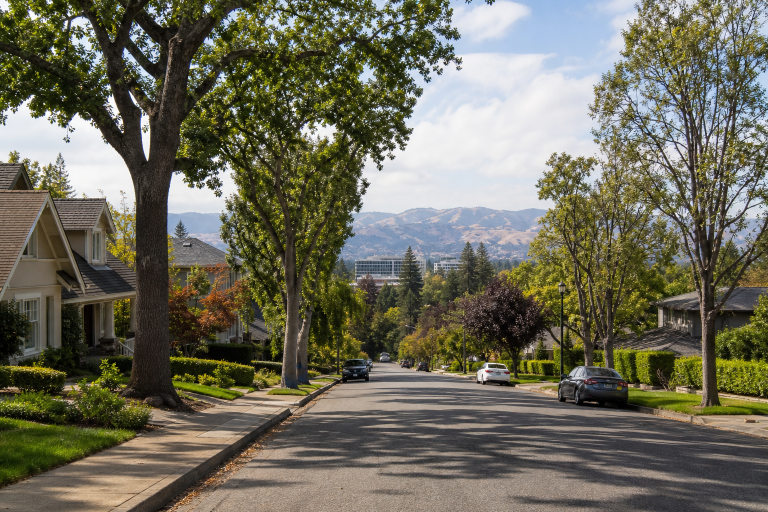
Silicon Valley communities can look very different from one block to the next. Compare lot dimensions, setbacks, sidewalk coverage, street lighting, tree canopy, drainage patterns, guest parking, and the distance between homes. Visit on foot when possible. A street that appears quiet in listing photos may feel entirely different when cars, deliveries, and neighborhood activity are underway. Consider the property’s long-term flexibility as well. If you may want an addition, a pool, a detached workspace, or an accessory dwelling unit, verify zoning, setbacks, permit requirements, and other local rules before treating that possibility as part of the home’s value.
Notice Noise, Hazards, and Nearby Change
Visit at several times of day and listen closely. Traffic, aircraft, trains, school activity, restaurants, construction, parks, and major roads can all affect a property’s experience. Look at the home’s location relative to these features rather than relying solely on a map pin. Buyers should also review applicable flood, wildfire, seismic, and other hazard disclosures, then discuss insurance availability and coverage with qualified insurance professionals. Research planned development, roadwork, transit projects, and construction near the property. These factors can influence both the ownership experience and future renovation plans.
Use Market News as Context
Regional headlines can help establish context, but they cannot determine the value of a particular house. Recent Silicon Valley housing market reporting has highlighted pressures affecting parts of the local market. In contrast, broader coverage of the Bay Area housing market illustrates how uneven conditions can be across communities and price ranges. For an actual offer decision, focus on recent comparable sales that match the home’s location, condition, lot, size, and amenities. Review local inventory, price reductions, days on market, and sale-to-list patterns within the specific neighborhood rather than relying on a countywide average.
Build a Neighborhood Scorecard
A simple scorecard can prevent a compelling staging job or a dramatic view from overshadowing daily-life priorities. Choose three to five areas that meet your basic budget and commute requirements, then score each one from one to five.
- Rate commute practicality, home value, outdoor access, noise exposure, privacy, and future flexibility.
- Give more weight to factors that affect your household every day.
- Revisit the highest-scoring neighborhoods on weekdays, evenings, and weekends.
- Update scores after reviewing disclosures, inspections, insurance estimates, and association documents.
Questions to Ask During a Visit
- How does traffic change during school drop-off and pickup?
- Where are groceries, parks, trails, libraries, and everyday services located?
- What nearby homes are being renovated, expanded, or replaced?
- Are road, transit, or development projects planned nearby?
- Does the home offer the level of activity, quiet, privacy, and convenience you want?
Make the Neighborhood Match the Life
The strongest Silicon Valley home search begins with a clear picture of daily life. By comparing ownership costs, commuting realities, housing characteristics, local services, environmental conditions, and future options, buyers can make a more informed decision. The right home is not simply the one that photographs best. It is the one that works well on an ordinary Tuesday in Menlo Park, California.
Conclusion
Buying a home in Menlo Park or elsewhere in Silicon Valley is ultimately a decision about how you want to live every day. Beyond the home’s size, finishes, and floor plan, buyers should consider commute times, schools, walkability, neighborhood character, ownership costs, noise, hazards, and future flexibility. Visiting different areas at realistic times and reviewing property-specific information can reveal details that are easy to miss during a single showing. By comparing these factors alongside recent market data and long-term household needs, buyers can narrow their choices with greater confidence. The best Silicon Valley home is not necessarily the most impressive listing, but the one that provides a practical balance of comfort, convenience, financial sustainability, and a lifestyle suited to the years ahead.